
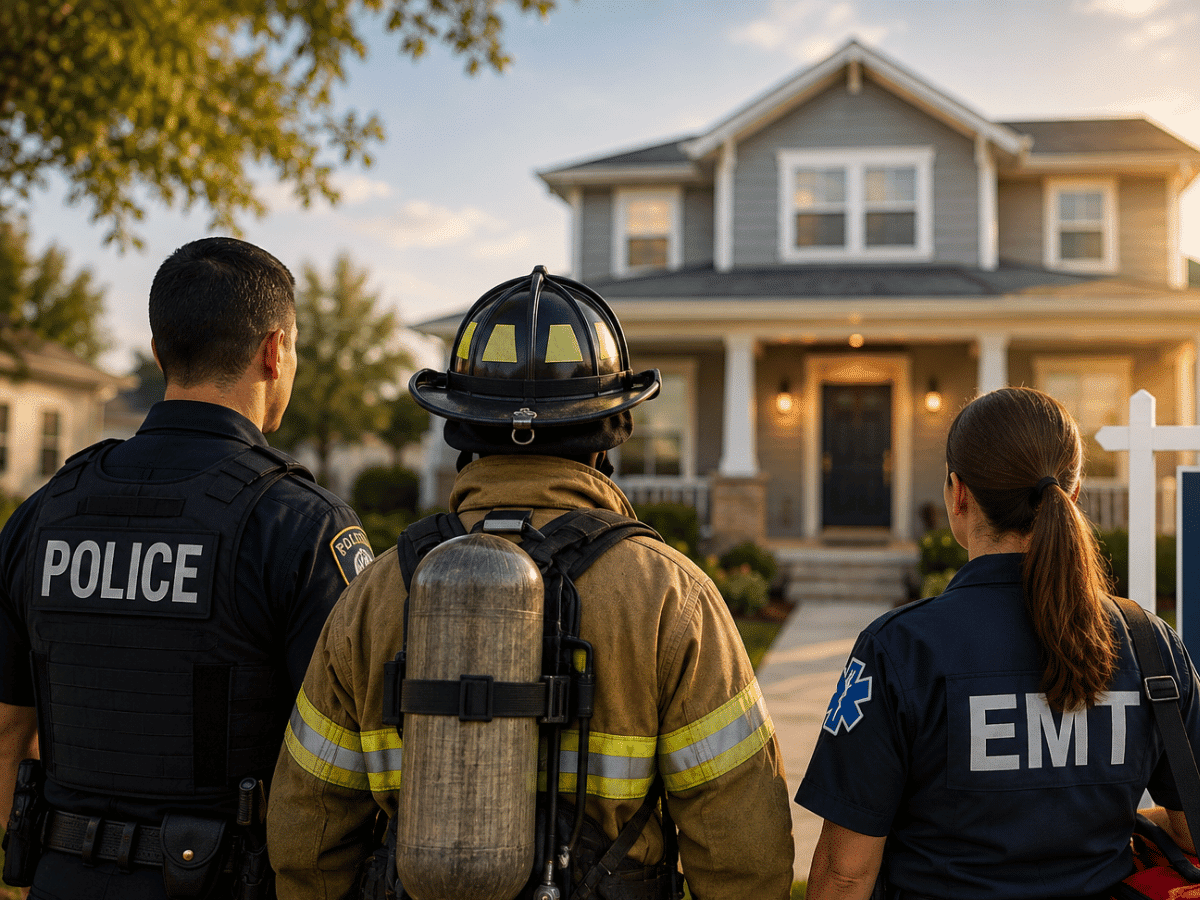
Key Takeaways:
- First responders can access specialized home loan programs offering reduced interest rates, down payment assistance, and closing cost help.
- Florida offers state-level programs specifically designed for first responders alongside federal options like FHA, VA, and USDA loans.
- Working with a local Florida mortgage broker gives you access to multiple lenders and programs in one place, saving time and money.
You put your life on the line every shift. The least the housing market can do is give you a fair shot at homeownership. The good news is it actually does — through a collection of programs, loan types, and assistance tools built specifically for people who do what you do.
First responder home loans aren’t a single product. They’re a category of financing options that, when stacked together correctly, can dramatically reduce what you pay upfront, lower your monthly payment, and make buying a home more realistic whether you’re a firefighter, paramedic, law enforcement officer, or emergency medical technician.
This guide breaks down every major program available to you, explains how eligibility works, and helps you understand what to prioritize when you’re ready to start the process.
What Qualifies as a First Responder Home Loan?
The term “first responder home loan” covers any mortgage program, grant, or assistance option that gives preferential treatment to qualifying public safety workers. This includes:
- Law enforcement officers (police, sheriffs, corrections)
- Firefighters and fire investigators
- Emergency medical technicians (EMTs)
- Paramedics
- 911 dispatchers (varies by program)
- Search and rescue personnel
Some programs are federally funded. Others are managed at the state level. Florida, in particular, has built out meaningful programs for first responders that go beyond what’s available nationally. Understanding both layers is essential before you apply anywhere.
Federal Loan Programs First Responders Should Know
FHA Loans
The Federal Housing Administration backs these loans, which means lenders take on less risk — and that risk reduction gets passed to you through looser qualification requirements.
FHA loans allow down payments as low as 3.5% with a credit score of 580 or higher. If your score is between 500 and 579, you can still qualify with 10% down. These thresholds are far more accessible than conventional loan standards, which is one reason FHA is popular among first responders who may carry student loans or other debt from years in public service.
The tradeoff is mortgage insurance. FHA loans require both an upfront mortgage insurance premium (MIP) and an annual premium — costs that remain for the life of the loan if your down payment is under 10%. Understanding this before committing matters.
VA Loans
If you’re a first responder who also served in the military, you may qualify for VA loan benefits, which are among the strongest in the mortgage industry. VA loans require zero down payment, no private mortgage insurance, and offer competitive interest rates backed by the Department of Veterans Affairs.
VA loans are not exclusive to active duty military. Veterans, surviving spouses, and certain National Guard and Reserve members also qualify. If this applies to you, it should be your first conversation with a lender.
USDA Loans
The U.S. Department of Agriculture offers zero-down mortgage financing in qualifying rural and some suburban areas. If you’re a first responder purchasing in a smaller Florida community or an area outside a major metro, USDA eligibility is worth checking. Income limits apply, but for many first responder salary levels, those limits align reasonably well.
HUD Good Neighbor Next Door Program
This is one of the most aggressive homebuyer benefits available to first responders and it’s often overlooked. The Good Neighbor Next Door (GNND) program offers HUD-owned properties in designated revitalization areas at a 50% discount off the listed price. That’s not a typo.
Eligible buyers include law enforcement officers, firefighters, and emergency medical technicians. To qualify, you must:
- Purchase the home as your sole primary residence
- Commit to living there for at least 36 months
- Be employed full-time by a law enforcement agency, fire department, or EMS agency serving the area where the home is located
The discount comes in the form of a silent second mortgage that carries no interest and requires no monthly payments. If you fulfill the 36-month occupancy requirement, the entire second mortgage is forgiven.
Inventory is limited and properties are listed on a weekly lottery basis through HUD’s official site. But when the right property shows up, the financial advantage is extraordinary.
Florida-Specific Programs for First Responders
Florida Hometown Heroes Program
This is the most significant state-level program available to Florida first responders right now. The Florida Hometown Heroes Program was designed specifically to help community workforce members — including firefighters, law enforcement officers, and EMTs — afford homes in the communities where they serve.
Here’s what the program provides:
- Down payment assistance of up to 5% of the first mortgage loan amount (maximum $35,000)
- A below-market first mortgage interest rate on FHA, VA, USDA, or conventional loans
- Closing cost assistance included within the down payment assistance amount
- The assistance is structured as a 0% interest, non-amortizing second mortgage
- No monthly payments on the second mortgage — it’s repaid only when the home is sold, refinanced, or the mortgage is paid off
Eligibility requirements for Hometown Heroes include:
- Full-time employment in a qualifying profession (includes police, fire, EMS, nurses, teachers, and other community workers)
- Annual income must not exceed $128,250 (subject to change — verify current limits)
- Must be a first-time homebuyer OR not have owned a home in the past three years
- Must occupy the property as a primary residence
- Complete a homebuyer education course
This program is one of the strongest tools in the Florida market for first responders. If you’re purchasing in Florida and you work in public safety, this should be part of your financing conversation from day one. Reach out to the team at Liberty Mortgage Lending Group to confirm your eligibility and check current program availability.
Florida Bond Programs and Other County-Level Options
Beyond the statewide Hometown Heroes initiative, individual Florida counties and municipalities sometimes operate their own down payment assistance programs or preferential rate programs for public employees. Miami-Dade, Broward, Palm Beach, Hillsborough, and Orange County have each maintained local assistance programs at various points.
These programs vary considerably in structure, availability, and funding cycles. A local mortgage broker with Florida-specific experience can tell you what’s active in your target county right now — which is far more useful than relying on information that may be months out of date.
How to Compare First Responder Loan Programs Side by Side
| Program | Down Payment Required | Mortgage Insurance | First Responder Specific | Key Limitation |
|---|---|---|---|---|
| FHA Loan | 3.5% (580+ credit) | Yes (MIP) | No — open to all | MIP can last the loan’s life |
| VA Loan | 0% | No | No — military only | Must have VA eligibility |
| USDA Loan | 0% | Low annual fee | No — open to all | Rural/suburban areas only |
| HUD GNND | 50% off list price | Varies | Yes — law enforcement, fire, EMS | Limited inventory, 3-yr requirement |
| FL Hometown Heroes | Minimal (assistance provided) | Varies by loan type | Yes — community workforce | Income limits, first-time buyer rules |
| Conventional Loan | 3–20% | Only if under 20% down | No — open to all | Stricter credit requirements |
What Lenders Look at When You Apply
Understanding what determines your approval — and your rate — gives you time to improve your position before you apply.
Credit Score
Most first responder programs accept credit scores in the 620–640 range for standard programs. FHA allows lower. A score above 700 unlocks better rate tiers across almost every loan product.
Debt-to-Income Ratio (DTI)
This is the percentage of your gross monthly income that goes toward debt payments. Most programs cap qualifying DTI at 45–50%. If you’re carrying significant debt from emergency vehicle payments, student loans, or other obligations, it’s worth calculating this before applying.
Employment Verification
Lenders want documentation of your full-time status and income. For first responders paid hourly with shift differentials or overtime, lenders typically average your overtime income over a 24-month period to determine qualifying income. Keep your pay stubs and tax returns organized.
Reserves
Some loan programs require you to show cash reserves — funds left over after closing. This doesn’t mean you need a large savings account, but having at least a few months of mortgage payments in reserve strengthens your application significantly.
Common Mistakes First Responders Make When Applying for Home Loans
Not checking all eligible programs before applying. Many first responders walk into a single lender’s office and take whatever product is offered without realizing better options exist. Checking all available assistance programs — federal, state, and county — before committing can save you tens of thousands of dollars.
Assuming VA benefits don’t apply. If you’ve served in any military branch, even part-time Guard or Reserve duty, confirm your VA eligibility before defaulting to a conventional or FHA loan. The VA program’s combination of zero down and no mortgage insurance is nearly impossible to beat.
Applying before addressing credit issues. A 30-point credit score difference can mean hundreds of dollars per month in mortgage payment difference. If your score is in the mid-600s, spending three to six months reducing credit card balances or disputing errors can meaningfully improve your rate.
Ignoring the Good Neighbor Next Door program. This program is dramatically underutilized simply because people don’t know it exists. If you’re flexible on location and willing to commit to three years in the property, the 50% discount is a generational wealth-building opportunity.
Not working with a broker who knows your market. A mortgage broker — unlike a bank — can shop your file across multiple lenders simultaneously. For first responders with slightly irregular income structures (shift differentials, overtime, secondary employment), this matters because different lenders underwrite that income differently.
Why Working with a Florida Mortgage Broker Makes a Difference
Banks have one product shelf. A mortgage broker has access to dozens of lenders, which means more programs, more flexibility, and more ways to structure your loan to fit your income profile.
For first responders navigating a mix of federal programs, state assistance options, and standard loan products, having a broker who understands how to layer these benefits together is a practical advantage. Liberty Mortgage Lending Group works with Florida homebuyers across the state, including those using the Hometown Heroes Program and other first responder-specific financing tools.
The team walks you through your options from application through closing — not just at the start, but at every decision point along the way. If you’re ready to understand exactly what you qualify for, contacting the team directly is the fastest way to get clarity.
Frequently Asked Questions About First Responder Home Loans
Can I use the Florida Hometown Heroes Program if I’m not a first-time homebuyer?
In most cases, the program requires you to be a first-time homebuyer or not have owned a home in the past three years. There are exceptions for veterans in some cases — confirm your specific situation with a participating lender.
Do first responders get better mortgage rates automatically?
Not automatically. The savings come through qualifying for specific assistance programs, down payment help, or below-market rate offerings tied to programs like Hometown Heroes. Your base mortgage rate is still influenced by your credit score, loan type, and market conditions.
Can I combine the Hometown Heroes Program with an FHA loan?
Yes. The Hometown Heroes Program is compatible with FHA, VA, USDA, and certain conventional loans. The first mortgage product and the assistance layer work together, which is why working with a lender familiar with the program is important.
What documents do I need to apply for a first responder home loan in Florida?
Standard documentation includes two years of tax returns, recent pay stubs (30 days), two months of bank statements, employer verification confirming full-time public safety employment, and a valid government-issued ID. If using Hometown Heroes, proof of qualifying employment and completion of a homebuyer education course are also required.
What happens if I sell my home before meeting the Good Neighbor Next Door 36-month requirement?
If you sell before the 36-month occupancy period ends, the silent second mortgage (the discounted portion) becomes due in full — prorated in some cases. HUD outlines specific repayment obligations if the commitment isn’t met. Review these terms carefully before purchasing through the GNND program.
Conclusion
First responder home loans aren’t a marketing gimmick. They represent real, substantive financial advantages — from zero-down VA loans to 50% property discounts through HUD’s Good Neighbor Next Door program to Florida’s robust Hometown Heroes assistance. The key is knowing what’s available, understanding how each program works, and making sure you apply through someone who actually knows how to put these pieces together.
Florida offers some of the strongest support in the country for first responders looking to own a home. Whether you’re a firefighter in Tampa, a law enforcement officer in Jacksonville, or a paramedic in South Florida, you have more options than you probably realize.
Ready to find out exactly what you qualify for? The team at Liberty Mortgage Lending Group specializes in helping Florida first responders navigate home loan programs and find financing that makes real sense for their situation. Contact us today and get personalized guidance from a team that knows Florida mortgage programs inside and out.