

Key Takeaways:
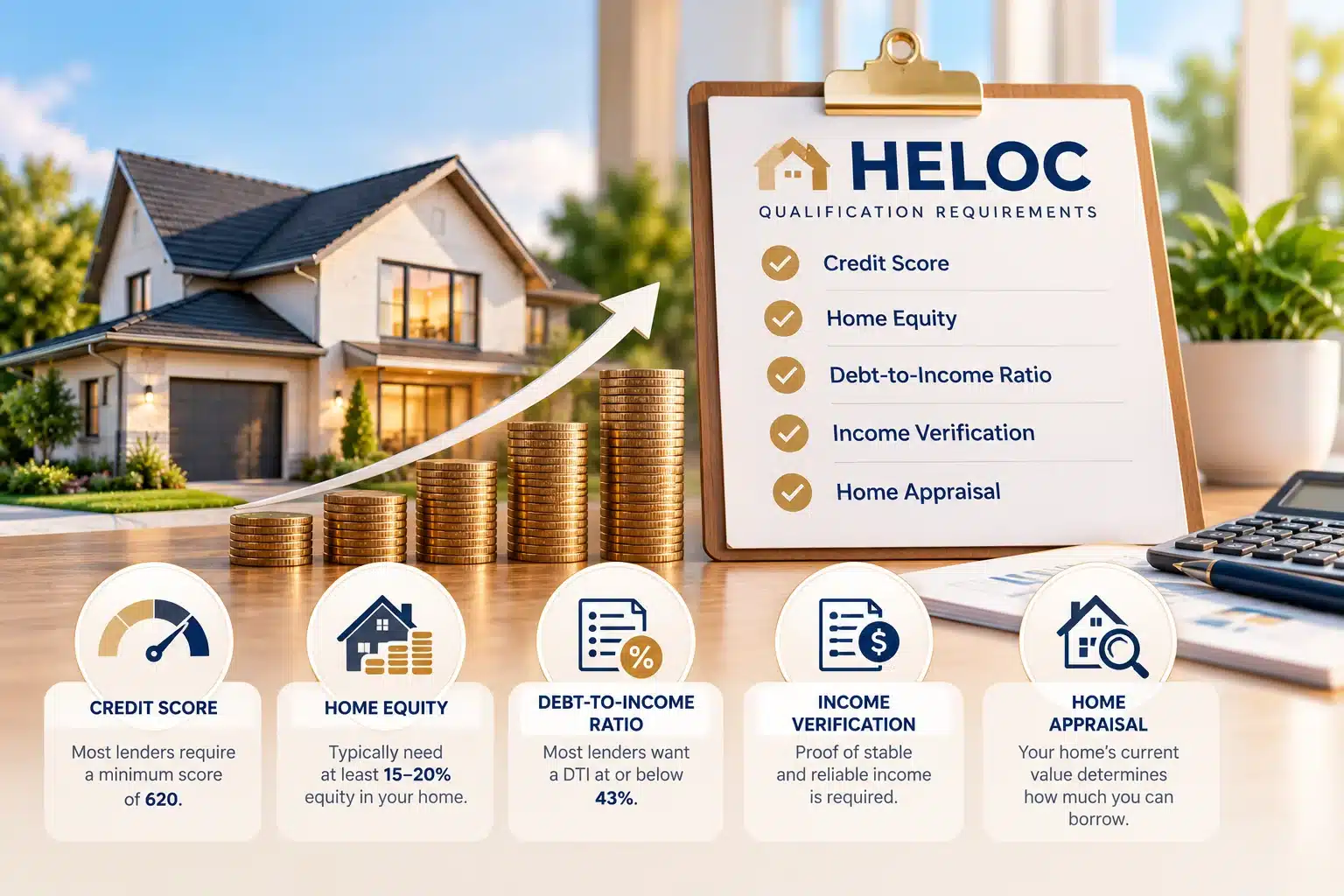
- Most lenders require a minimum credit score of 620, at least 15–20% home equity, and a debt-to-income ratio below 43% to qualify for a HELOC.
- Your home’s appraised value directly impacts how much credit you can access — the more equity you’ve built, the stronger your borrowing position.
- Shopping multiple lenders and understanding your financial profile before applying significantly increases approval odds and helps secure better terms.
A Home Equity Line of Credit — commonly called a HELOC — gives homeowners a flexible way to tap into the equity they’ve built in their property. It works similarly to a credit card: you’re approved for a maximum credit limit, and you draw from it as needed during the draw period, typically five to ten years. After that, repayment begins.
But getting approved isn’t automatic. Lenders scrutinize several layers of your financial life before extending this kind of credit. Understanding exactly what they look for — and how to position yourself accordingly — makes the difference between approval and rejection.
What Is Home Equity and Why Does It Matter?
Home equity is the portion of your property you actually own outright. It’s calculated by subtracting your remaining mortgage balance from your home’s current market value.
If your home is worth $400,000 and you owe $250,000 on your mortgage, you have $150,000 in equity — or 37.5%. That equity is the foundation lenders build every HELOC decision on.
Most lenders won’t let you borrow against 100% of that equity. They maintain a buffer known as the combined loan-to-value ratio (CLTV). The majority of lenders cap the CLTV at 80% to 85%, meaning your existing mortgage plus your HELOC cannot exceed that percentage of your home’s value.
Using the example above:
- Home value: $400,000
- 85% CLTV maximum: $340,000
- Existing mortgage: $250,000
- Maximum HELOC: $90,000
The more equity you’ve accumulated, the more room you have to borrow.
Minimum Credit Score Requirements
Credit score is one of the first things lenders check. Most require a minimum score of 620, though some set the bar at 680 or higher for competitive rates. Borrowers with scores above 720 typically receive the best terms — lower interest rates and higher credit limits.
A HELOC is a second lien against your property, which means the lender takes on more risk than your primary mortgage holder. That risk gets priced into your interest rate. A lower credit score signals higher risk, which translates directly into higher borrowing costs.
Before applying, it’s worth pulling your credit reports from all three bureaus — Equifax, Experian, and TransUnion — and checking for errors. Disputing inaccuracies and paying down revolving balances before applying can meaningfully bump your score in a short period.
Debt-to-Income Ratio Explained
Your debt-to-income ratio (DTI) compares your monthly debt obligations to your gross monthly income. Lenders use it to evaluate whether you can realistically handle a new payment on top of your existing financial commitments.
Most HELOC lenders want to see a DTI at or below 43%. Some lenders allow up to 50% depending on other compensating factors — strong credit, significant equity, or substantial cash reserves — but 43% is the widely accepted benchmark.
How to calculate your DTI:
- Add up all recurring monthly debt payments (mortgage, car loans, student loans, credit card minimums).
- Divide that total by your gross monthly income (before taxes).
- Multiply by 100 to get your percentage.
If your gross monthly income is $8,000 and your total monthly debts are $3,200, your DTI is 40% — within range for most lenders.
Reducing outstanding debt before applying is one of the most effective ways to improve your DTI. Even paying off a small installment loan can shift your ratio meaningfully.
Income Verification and Employment Stability
Lenders don’t just want to know what you earn — they want to know it’s reliable. W-2 employees typically submit their two most recent pay stubs and two years of tax returns. Self-employed borrowers face more scrutiny, often needing two years of business tax returns, profit and loss statements, and bank statements.
Employment history matters too. A borrower who recently changed jobs or industries — even at a higher salary — may raise lender concerns. Generally, lenders prefer to see at least two years of stable employment in the same field.
For self-employed borrowers or those with non-traditional income (rental income, freelance contracts, investment dividends), documenting every income stream thoroughly is critical. Inconsistent or undocumented income is one of the fastest routes to a denied application.
Home Appraisal: The Number That Changes Everything
Because the HELOC is secured by your home, lenders need to confirm its current market value before approving you. This typically involves a formal appraisal performed by a licensed appraiser, though some lenders use automated valuation models (AVMs) for straightforward cases.
The appraisal outcome matters more than most borrowers expect. If your home appraises lower than anticipated, your available equity shrinks — sometimes significantly — even if you’ve been making payments for years.
Factors that influence your appraisal value include:
- Comparable home sales in your neighborhood
- Recent renovations or improvements
- General condition and maintenance of the property
- Local market conditions
Before applying, take stock of what might negatively impact your appraisal. Deferred maintenance, dated fixtures, or unpermitted additions can drag the number down. Addressing visible issues before the appraiser visits can protect your equity position.
HELOC Requirements at a Glance
The following table summarizes the standard qualification benchmarks most U.S. lenders apply when evaluating HELOC applications:
| Qualification Factor | Minimum Requirement | Ideal Target |
|---|---|---|
| Credit Score | 620 | 720+ |
| Home Equity | 15–20% | 25%+ |
| Debt-to-Income Ratio | Below 43% | Below 36% |
| Combined Loan-to-Value (CLTV) | 80–85% max | Below 80% |
| Employment History | 2 years stable | 2+ years same industry |
| Income Documentation | Pay stubs + tax returns | Consistent and fully documented |
These figures represent general benchmarks. Individual lenders may adjust requirements based on their risk appetite, current market conditions, or state-specific regulations.
How HELOC Rates Work — Fixed vs. Variable
Most HELOCs carry variable interest rates tied to the prime rate, which moves in response to Federal Reserve policy decisions. When the Fed raises rates, HELOC rates climb with them. When rates fall, borrowers benefit.
Some lenders offer a fixed-rate conversion option, allowing borrowers to lock a portion of their outstanding HELOC balance at a fixed rate. This provides predictability during the repayment phase if market rates look volatile.
Understanding how rate adjustments work — and how much your payment could theoretically increase — is essential before signing any HELOC agreement. Ask lenders for worst-case payment scenarios based on their rate caps.
The HELOC Application Process, Step by Step
Knowing what to expect reduces stress and speeds up the timeline. Here’s how the process typically unfolds:
- Check your credit and equity position. Review your credit reports, estimate your current home value, and calculate your approximate available equity before approaching any lender.
- Gather your documentation. This includes pay stubs, W-2s or tax returns (two years), bank statements, and your current mortgage statement.
- Shop multiple lenders. Rates, fees, and terms vary considerably between banks, credit unions, and mortgage brokers. Getting at least three quotes is standard practice.
- Submit your application. The lender will pull your credit, verify your income, and order an appraisal.
- Review the loan disclosure. Federal law requires lenders to give you a disclosure document detailing rates, terms, fees, and repayment terms before closing.
- Close and access your credit line. After a three-day right of rescission (required by law for most HELOCs), your line becomes active and accessible.
The entire process commonly takes three to six weeks from application to funding.
Common Reasons HELOC Applications Get Denied
Understanding the pitfalls helps borrowers avoid them. The most frequent reasons applications are declined include:
- Insufficient equity. If your CLTV exceeds the lender’s maximum, there’s no room to extend a line of credit.
- Low credit score. Scores below 620 disqualify applicants at most lenders.
- High DTI. Too much existing debt relative to income signals repayment risk.
- Unstable income. Gaps in employment, recent job changes, or unverifiable self-employment income raise red flags.
- Low appraisal. A home that appraises below expectations reduces available equity and can disqualify an otherwise solid application.
- Recent bankruptcy or foreclosure. Most lenders require a waiting period of two to seven years after major negative credit events.
If you’re denied, lenders are required to provide an adverse action notice explaining why. Use that information strategically to address the specific gap before reapplying.
HELOC vs. Other Home Equity Options
A HELOC isn’t the only way to access home equity. Borrowers should understand how it compares to alternatives before deciding which product fits their situation.
A home equity loan delivers a lump sum at a fixed interest rate, repaid over a set term. It’s better suited for a single, defined expense — a roof replacement or medical bill — rather than ongoing costs.
A cash-out refinance replaces your existing mortgage with a new, larger loan and gives you the difference in cash. This may make sense if current mortgage rates are lower than your existing rate. Borrowers exploring this option should compare current rates for conventional loans and government-backed loan programs to determine whether refinancing aligns with their broader financial goals.
For veterans, a VA-backed cash-out refinance through a VA home loan program may offer superior terms — including no private mortgage insurance and competitive interest rates.
First-time buyers or borrowers with lower credit scores looking to build equity faster might also explore FHA loan programs, which allow lower down payments and more flexible qualifying criteria.
Healthcare professionals with unique income structures should consider whether a doctor loan provides a better pathway to building the equity position needed to qualify for a HELOC down the road.
How to Strengthen Your HELOC Application Before Applying
There’s rarely a reason to apply cold. Taking deliberate steps to improve your financial profile before submitting an application increases approval odds and often unlocks better rates.
Practical steps to take:
- Pay down credit card balances to reduce your utilization ratio and improve your credit score.
- Avoid opening new credit accounts in the months before applying.
- If your DTI is too high, prioritize paying off installment loans with small remaining balances.
- Make sure your home is well-maintained before the appraisal visit.
- Build a paper trail for all income sources, especially if self-employed.
- If you’re close to the equity threshold, consider making extra principal payments on your mortgage to increase your equity position before applying.
Timing also matters. Applying during a period of rising home values in your local market can increase your appraised value and therefore your available equity — without any action on your part.
Working With a Mortgage Broker in Florida
Navigating HELOC options alone is possible, but it’s rarely optimal. Lenders each have distinct underwriting guidelines, rate structures, and fee schedules. What disqualifies a borrower at one institution may be well within range at another.
If you’re searching for a mortgage broker in Florida, working with a team that specializes in comparing loan programs across multiple lenders gives you access to a broader range of options than approaching a single bank directly. An experienced broker understands current mortgage rates, knows which lenders have the most favorable HELOC guidelines, and can help position your application for the strongest possible outcome.
Whether you’re tapping equity to fund a renovation, consolidate debt, or cover major expenses, having a knowledgeable advocate in your corner makes the process considerably more efficient.
Frequently Asked Questions
What is the minimum credit score needed to qualify for a HELOC?
Most lenders require a minimum credit score of 620, though many prefer 680 or higher. Borrowers with scores above 720 typically receive the most competitive rates and terms.
How much equity do you need in your home to get a HELOC?
Generally, lenders require you to retain at least 15–20% equity in your home after accounting for the HELOC. Your combined loan-to-value ratio — your mortgage plus the HELOC — typically cannot exceed 80–85% of your home’s appraised value.
Can self-employed borrowers qualify for a HELOC?
Yes, but the documentation requirements are more extensive. Most lenders want two years of business and personal tax returns, profit and loss statements, and bank statements to verify income consistency.
How long does it take to get approved for a HELOC?
The typical timeline runs between three and six weeks from application submission to funding. The appraisal process often drives the timeline more than any other single step.
Is HELOC interest tax deductible?
In some cases, yes. Interest on a HELOC may be deductible if the funds are used to buy, build, or substantially improve the home securing the line of credit. Consult a qualified tax professional to determine how this applies to your specific situation, as the rules have changed since 2017.