
Key Takeaways:
- HELOC closing costs in Florida typically range from 2% to 5% of the credit line amount, though many lenders offer low- or no-closing-cost options.
- Florida-specific fees — including documentary stamp taxes and title search costs — can add hundreds to your total upfront expenses.
- Understanding every line item before you sign helps you compare lenders accurately and avoid surprises at the table.
If you own a home in Florida and you’re thinking about tapping into your equity, a Home Equity Line of Credit (HELOC) is one of the most flexible tools available. But before you start picturing what you’ll do with those funds, it’s worth slowing down to look at the costs attached to opening one.
Closing costs on a HELOC aren’t as heavy as those on a first mortgage, but they’re real, they add up, and in Florida specifically, there are a few state-level fees that can catch borrowers off guard. Here’s what you actually need to know.
What Is a HELOC, and How Does It Work in Florida?
A HELOC is a revolving line of credit secured by the equity in your home. You’re approved for a maximum draw amount, and you can borrow against it, repay it, and borrow again during the draw period — usually 10 years. After that, you enter a repayment period where you pay down whatever balance remains.
Florida homeowners use HELOCs for everything from home renovations and debt consolidation to education expenses and emergency reserves. The appeal is obvious: you only pay interest on what you actually use, and the rates are typically lower than unsecured personal loans or credit cards.
But like any secured loan product, opening a HELOC involves origination and administrative costs. Some lenders roll these into the product. Others charge them upfront. And Florida has a few statutory costs that don’t exist in every other state.
Typical HELOC Closing Cost Ranges in Florida
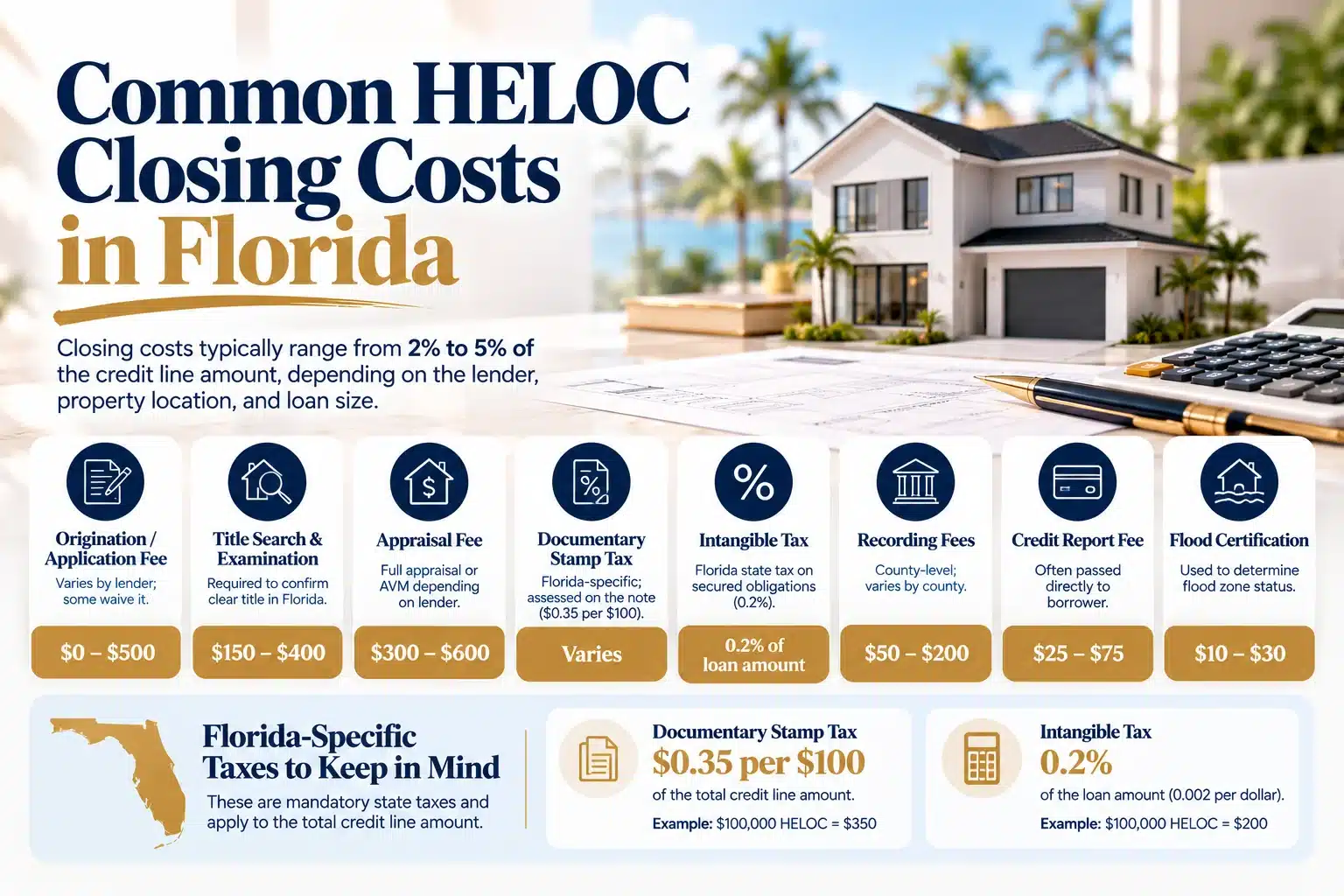
Most HELOC closing costs in Florida fall between 2% and 5% of the total credit line. On a $75,000 HELOC, that’s anywhere from $1,500 to $3,750. On a $150,000 line, you’re potentially looking at $3,000 to $7,500.
That range is wide because the actual costs depend on several variables: the lender you choose, the size of your credit line, your property’s location within Florida, and which fees your lender absorbs versus passes on to you.
Here’s a breakdown of the most common line items you’ll see:
| Fee Type | Typical Cost Range | Notes |
|---|---|---|
| Origination / Application Fee | $0 – $500 | Varies widely by lender; some waive it |
| Title Search & Examination | $150 – $400 | Required to confirm clear title in Florida |
| Appraisal Fee | $300 – $600 | Full appraisal or AVM depending on lender |
| Documentary Stamp Tax | Varies (see below) | Florida-specific; assessed on the note |
| Intangible Tax | 0.2% of loan amount | Florida state tax on secured obligations |
| Recording Fees | $50 – $200 | County-level; varies by county |
| Credit Report Fee | $25 – $75 | Often passed directly to borrower |
| Flood Certification | $10 – $30 | Used to determine flood zone status |
Florida-Specific Fees You Won’t See Everywhere Else
This is where Florida stands apart from most states. Two taxes in particular tend to surprise borrowers who’ve previously taken out home equity products in other states.
Documentary Stamp Tax
Florida imposes a documentary stamp tax on promissory notes secured by real property. For HELOCs, this is generally calculated at $0.35 per $100 of the total credit line amount. On a $100,000 HELOC, that’s $350 just in doc stamps — before any other costs are factored in.
The calculation is applied to the maximum line amount, not just what you draw down. So even if you plan to use only $30,000 of a $100,000 line, you’re paying the tax on the full $100,000.
Intangible Tax
Florida also levies an intangible tax on secured notes at a rate of $0.002 per dollar of the loan amount — effectively 0.2%. On that same $100,000 HELOC, that’s another $200. Combined with documentary stamp tax, you’re already looking at $550 in state-level taxes alone.
These aren’t negotiable. They’re statutory, and every lender operating in Florida must collect them.
No-Closing-Cost HELOCs: Are They Actually Free?
Some lenders advertise no-closing-cost or low-closing-cost HELOCs, and these deals do exist. But “no closing cost” doesn’t mean free — it typically means the lender is absorbing those costs in exchange for something else, usually a slightly higher interest rate or a requirement that you keep the line open for a minimum period.
Common tradeoffs on no-closing-cost HELOCs include:
- Rate premium: Your starting rate may be 0.25% to 0.50% higher than a comparable product with closing costs.
- Early closure fee: If you close the HELOC within 24 to 36 months, many lenders will recapture some or all of the waived closing costs. These fees often range from $300 to $500 and sometimes more.
- Mandatory draw requirements: Some lenders require you to draw a minimum amount at closing — often 75% to 90% of the credit line — which negates some of the flexibility that makes a HELOC attractive.
For Florida borrowers, even “no-closing-cost” HELOCs still typically require the borrower to pay documentary stamp tax and intangible tax, since those are state-mandated and the lender legally cannot absorb them.
So when you see a no-closing-cost offer in Florida, confirm exactly which fees are being waived and which are still your responsibility. The state taxes almost certainly are.
How HELOC Costs Compare to Other Loan Types
If you’re weighing a HELOC against other options, it helps to see how the cost structures compare. A conventional loan used for a cash-out refinance, for example, comes with its own set of closing costs — typically 2% to 6% of the total loan amount — but it replaces your existing mortgage rather than sitting alongside it.
An FHA loan isn’t generally used for equity access purposes, but if you’re a first-time buyer trying to preserve cash, understanding how FHA closing costs work versus a future HELOC can inform your long-term financial planning. FHA products include mortgage insurance premiums that HELOCs don’t carry.
VA home loans offer one of the most cost-effective entry points for eligible veterans, but VA loans don’t include a HELOC product directly. Veterans who want equity access may need to explore a VA cash-out refinance instead, which carries different cost assumptions.
The point is: context matters. A HELOC’s closing costs may look small compared to a full refinance, but the right choice depends on your current rate, how much equity you want to access, and how long you plan to stay in the home.
What Affects Your Specific Closing Costs
Your actual closing costs won’t necessarily match the averages. Several personal and property-level factors push costs up or down:
Credit line size: Most fees — including state taxes — scale with the credit line amount. A larger HELOC means higher absolute costs, even if the percentage stays roughly the same.
Property location within Florida: Recording fees vary by county. Miami-Dade, Broward, and Palm Beach counties each have slightly different fee structures. Rural counties may have lower fees in some categories.
Lender type: Banks, credit unions, and mortgage brokers all approach HELOC pricing differently. Brokers can often access multiple lenders and shop for better fee structures, whereas a single bank offers only their own product.
Appraisal method: Some lenders use automated valuation models (AVMs) to estimate your home’s value, which significantly reduces or eliminates the traditional appraisal fee. Others require a full in-person appraisal, especially for larger credit lines or properties in less-common markets.
Loan-to-value ratio: If your LTV is very low — meaning you have substantial equity — some lenders may offer better terms or absorb more costs to compete for your business.
How to Reduce What You Pay at Closing
There are legitimate ways to lower your HELOC closing costs — without taking on terms that hurt you later.
Shop multiple lenders. This is the single most effective step. Fee structures vary significantly across lenders in Florida. What one bank charges $400 for, another might waive entirely. Working with a mortgage broker gives you access to multiple lender options without requiring you to apply individually to each one.
Negotiate the lender fees. Origination fees, application fees, and processing fees are negotiable. Unlike state taxes, these are at the lender’s discretion. Ask directly which fees they’re willing to reduce or waive.
Consider timing your draw. If the lender’s early closure fee would effectively wipe out the savings from a no-closing-cost offer, and you’re unsure how long you’ll keep the line, paying costs upfront may actually protect you financially over a longer horizon.
Ask about bundled products. If you have an existing checking or savings account with a lender, many will offer fee discounts as a relationship incentive. Credit unions especially tend to offer reduced fees to existing members.
Review the Loan Estimate carefully. Under federal law, lenders must provide a Loan Estimate within three business days of your application. Go through every line item and ask about any charge that isn’t clearly explained. You’re entitled to that transparency before you commit.
What Happens If You Close Your HELOC Early?
This is a conversation most borrowers skip, and it can be costly. Many Florida lenders include early termination clauses in HELOC agreements — particularly when they’ve waived closing costs upfront.
Early closure fees typically activate if you close the line within the first two to three years. The fee may be a flat dollar amount (often $300 to $500) or a percentage of the original credit line. In some cases, lenders recapture the exact closing costs they initially absorbed.
Before signing, read the section of your HELOC agreement that covers termination and early payoff. If you’re uncertain about your long-term plans — maybe you’re considering selling the home or refinancing in the next few years — weigh those fees against your options carefully.
“The best HELOC isn’t always the one with the lowest upfront cost. It’s the one where the total cost structure fits your actual borrowing timeline and usage pattern.”
Working With a Florida Mortgage Professional
Navigating HELOC closing costs is easier when you’re not doing it alone. Florida has specific regulations and tax obligations that don’t apply in other states, and lender offerings vary widely across the market.
At Liberty Mortgage Lending Group, we work with Florida homeowners to help them understand what they’re actually paying for — and why — before they commit to any product. Whether you’re exploring a HELOC for a renovation project or comparing it against a doctor loan or cash-out refinance, our team can walk you through the full cost picture and help you make the choice that aligns with your goals.
We’re a Florida-based mortgage brokerage, which means we have access to multiple lenders and the local knowledge to anticipate the costs that come with borrowing in this state specifically. You won’t get generic national estimates from us — you’ll get real numbers based on your property, your credit, and your equity position.
Conclusion
HELOC closing costs in Florida are manageable, but they’re not invisible. Between lender fees, appraisal costs, and Florida’s documentary stamp and intangible taxes, you should expect to budget at least several hundred to a few thousand dollars in upfront expenses depending on your credit line size. No-closing-cost options exist, but they come with tradeoffs worth understanding before you sign.
The most important move you can make is to compare multiple lenders, read every line of your Loan Estimate, and work with someone who understands Florida’s specific fee environment. When you know what you’re paying and why, the process becomes a lot less stressful — and a lot more straightforward.
Frequently Asked Questions
What are typical HELOC closing costs in Florida?
Florida HELOC closing costs generally range from 2% to 5% of the credit line amount. This includes lender fees like origination and appraisal costs, plus Florida-specific charges like documentary stamp tax (0.35% of the credit line) and intangible tax (0.2% of the loan amount). A $100,000 HELOC could carry $2,000 to $5,000 or more in total costs.
Does Florida charge documentary stamp tax on a HELOC?
Yes. Florida requires documentary stamp tax on promissory notes secured by real property, including HELOCs. The rate is $0.35 per $100 of the total credit line. This applies to the full line amount, not just what you draw.
Can I get a no-closing-cost HELOC in Florida?
Some lenders offer no-closing-cost HELOCs in Florida, but be aware that state-mandated taxes — including documentary stamp and intangible taxes — are typically still the borrower’s responsibility. The “no-cost” waiver usually applies only to lender-controlled fees. You may also face a higher interest rate or an early closure penalty.
How does a HELOC compare to a cash-out refinance in terms of closing costs?
A cash-out refinance replaces your existing mortgage and carries full closing costs — usually 2% to 6% of the loan amount. A HELOC is a second lien and typically has lower closing costs. However, if your first mortgage has a very low interest rate, a cash-out refi could increase your overall cost significantly, making a HELOC more cost-effective in many scenarios.
How long does it take to close a HELOC in Florida?
Most HELOCs in Florida close within 2 to 6 weeks from application, depending on the lender, the complexity of your application, and how quickly the title search and appraisal are completed. Some lenders offer expedited processing with AVM appraisals, which can shorten the timeline considerably.
Ready to explore your options? Liberty Mortgage Lending Group is here to help you understand your HELOC options and compare real closing cost figures specific to your Florida property — contact our team today to get started.