
Key Takeaways:
- Most home loan programs require a minimum credit score between 500 and 700, depending on the loan type.
- Your credit score directly influences your interest rate, monthly payment, and total loan cost over time.
- You can take targeted steps to improve your score before applying, potentially saving thousands of dollars.
Your credit score is one of the first things a lender looks at when you apply for a home loan. It tells lenders how reliably you’ve managed debt in the past, and it heavily influences what loan programs you qualify for, what interest rate you receive, and how much house you can realistically afford. Understanding where you stand — and what to do about it — puts you in a much stronger position before you ever submit an application.
What Is a Credit Score and Why Does It Matter for a Mortgage?
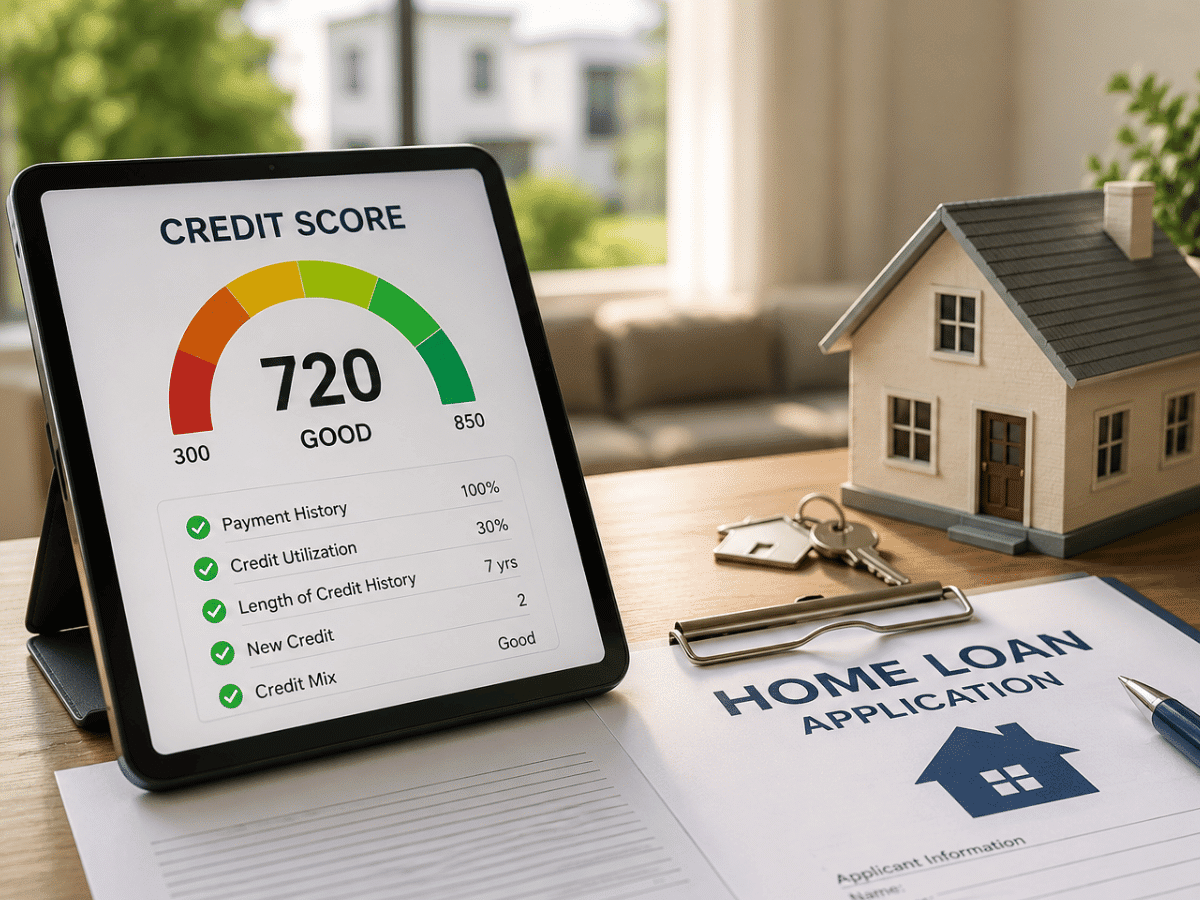
A credit score is a three-digit number, typically ranging from 300 to 850, generated by credit bureaus based on your borrowing and repayment history. The most commonly used model in mortgage lending is the FICO score. Lenders pull your score from all three major bureaus — Equifax, Experian, and TransUnion — and typically use the middle score for qualification purposes.
For home loans, this number carries real financial weight. A score of 760 versus a score of 660 can translate to a meaningfully lower interest rate on the same loan amount. Over a 30-year mortgage, that difference can cost or save you tens of thousands of dollars. It’s not just about qualifying — it’s about qualifying well.
Minimum Credit Score Requirements by Loan Type
Different mortgage programs carry different minimum credit score thresholds. Here’s a clear breakdown of what most lenders require:
| Loan Type | Minimum Credit Score | Key Benefit |
|---|---|---|
| FHA Loan | 500–580 | Low down payment (3.5% with 580+ score) |
| VA Loan | Typically 580–620 | No down payment for eligible veterans |
| Conventional Loan | 620–640 | No mortgage insurance with 20% down |
| USDA Loan | 640 | 100% financing for rural areas |
| Doctor Loan | 680–700 | Flexible DTI; designed for medical professionals |
These are baseline numbers. Individual lenders often impose their own “overlays,” which are stricter standards layered on top of program minimums. Working with a mortgage broker gives you access to multiple lenders and a better chance of finding one whose requirements match your profile.
If you’re a first-time buyer with a lower score, an FHA loan may be your most accessible entry point into homeownership. FHA loans allow scores as low as 500 with a 10% down payment, or 580 with just 3.5% down. For veterans and active-duty military, a VA home loan offers exceptional terms with no down payment required, and many VA lenders accept scores in the 580–620 range.
How Your Score Affects Your Interest Rate
Credit score tiers directly shape the interest rate a lender offers you. Lenders price risk — the lower your score, the higher the perceived risk, and the higher the rate you’ll pay to compensate.
Here’s a practical way to think about it. On a $350,000 home loan with a 30-year fixed rate:
- A borrower with a 760+ score might qualify for a rate of around 6.5%
- A borrower with a 680 score could be looking at closer to 7.0%
- A borrower with a 640 score might face 7.5% or higher
At those figures, the 760-score borrower saves roughly $100–$150 per month compared to the 640-score borrower. That adds up to $36,000–$54,000 over the life of the loan. Your credit score isn’t just a qualification hurdle — it’s a pricing mechanism.
The Five Factors That Build Your Credit Score
Your FICO score is calculated using five weighted components. Knowing what drives it helps you target improvements strategically:
- Payment history (35%) — The single biggest factor. One missed payment can drop your score significantly, especially if it’s recent.
- Credit utilization (30%) — How much of your available revolving credit you’re using. Keeping this below 30% is generally recommended, but below 10% is ideal when preparing to apply for a mortgage.
- Length of credit history (15%) — Older accounts generally help your score. Avoid closing old cards unless absolutely necessary.
- Credit mix (10%) — Having a variety of credit types (installment loans, credit cards) demonstrates you can manage different forms of debt.
- New credit inquiries (10%) — Every hard inquiry from a new credit application can temporarily ding your score. Limit applications in the months before you apply for a home loan.
How to Improve Your Credit Score Before Applying
If your score isn’t where you need it to be, there are concrete, time-tested strategies that can move the needle. Some work quickly; others take more time.
Pay down revolving debt aggressively. Credit utilization is one of the fastest factors to change. If you’re carrying $8,000 in balances against $20,000 in available credit, that’s 40% utilization. Paying that down to $4,000 brings you to 20%, which can noticeably improve your score within 30–60 days after your card issuers update the balances.
Dispute inaccurate information. Pull your credit reports from all three bureaus at AnnualCreditReport.com and review them closely. Errors are more common than people think — incorrect account statuses, duplicate negative items, payments marked late that were actually on time. Disputing and correcting errors can produce meaningful score improvements without requiring any behavioral change on your part.
Avoid opening new accounts. Each new credit application triggers a hard inquiry. While a single inquiry only costs you a few points, opening multiple accounts in a short window also lowers your average account age and signals potential financial stress. Hold off on new credit cards, auto loans, or personal loans while you’re preparing to buy.
Keep old accounts open. Closing a credit card you no longer use might feel responsible, but it reduces your total available credit and can increase your utilization ratio. It also shortens your average credit history. Leave older accounts open, even if you rarely use them.
Become an authorized user. If a family member or close friend has a long-standing credit card with a low balance and perfect payment history, being added as an authorized user can give your score a meaningful lift by extending your credit history and improving your utilization.
Make payments on time, without exception. Payment history is 35% of your score. If you have recent late payments, the most powerful thing you can do is establish a consistent streak of on-time payments going forward. The impact of a late payment fades over time — but only if it isn’t followed by more.
Credit Score Myths That Cost Buyers
A lot of misinformation floats around about credit scores and mortgage applications. Clearing up a few persistent myths can protect you from making decisions that inadvertently hurt your position.
Myth: Checking your own credit hurts your score.
Checking your own credit is a soft inquiry and has zero impact on your score. You can monitor it as often as you like. What causes score drops is hard inquiries generated by lenders when you apply for new credit.
Myth: You need perfect credit to buy a home.
You don’t. As the loan type table above shows, scores in the 500s can still qualify for certain programs. Perfect credit gets you better pricing, but it’s not a prerequisite for homeownership.
Myth: Carrying a small balance on your credit card helps your score.
This is a widely repeated myth with no basis in fact. Carrying a balance means you’re paying interest for no scoring benefit. Paying your balance in full each month is better for both your score and your finances.
Myth: All mortgage lenders look at the same credit score.
Lenders can use different credit scoring models, and some programs have specific requirements. A mortgage broker can help you understand which scores matter most for the loan programs you’re considering.
What Happens If You’re on the Credit Score Borderline
Being right at the edge of a qualification threshold — say, a 618 score when a program requires 620 — isn’t always a dead end. A few options are worth exploring:
First, your mortgage broker may be able to use a rapid rescore. This is a service where your broker works with a credit reporting agency to quickly update your file after you’ve paid down debt or resolved an error. Some borrowers see score movement within 3–5 business days through this process.
Second, you might consider a co-borrower. Adding someone with stronger credit to your application can help the overall profile, though the co-borrower takes on full legal responsibility for the loan.
Third, a short waiting period combined with deliberate credit-building actions may be the cleanest path forward. Even 60–90 days of focused effort — reducing balances, removing errors, making on-time payments — can move a borderline score into qualifying territory.
Loan Options at Liberty Mortgage Lending Group
The right loan program depends on your credit score, your down payment, your income, and your specific homeownership goals. At Liberty Mortgage Lending Group, we work with Florida homebuyers across the credit spectrum to match them with loan programs that make sense for their situation.
If you have strong credit and at least 5–20% for a down payment, a conventional loan often delivers the most competitive long-term cost. For buyers who qualify through federal programs, our government loan options cover a range of needs beyond the standard FHA and VA offerings. Medical professionals managing high student debt loads should look closely at the doctor loan program, which is built to accommodate the unique financial profile of physicians, dentists, and other healthcare professionals.
How Lenders Actually Evaluate Your Full Application
Your credit score is the starting point, not the finish line. Lenders look at your complete financial picture, including:
- Debt-to-income ratio (DTI): Your total monthly debt payments divided by your gross monthly income. Most programs cap this at 43–50%.
- Employment history: Lenders prefer at least two years of consistent employment in the same field.
- Down payment and reserves: More assets on hand signal financial stability and reduce lender risk.
- Loan-to-value ratio (LTV): A larger down payment lowers your LTV and often results in better pricing.
A borrower with a 700 credit score and strong income, low debt, and solid reserves can often out-qualify a borrower with a 750 score who carries high monthly obligations. Think of your application as a complete package rather than a single metric.
Frequently Asked Questions
What credit score do I need to buy a house?
The minimum credit score to buy a house depends on the loan program. FHA loans accept scores as low as 500 (with 10% down) or 580 (with 3.5% down). Conventional loans typically require a 620 or higher. VA loans vary by lender but often start around 580–620. The higher your score, the better your rate and terms will be, regardless of the program.
Does applying for a mortgage hurt my credit score?
Yes, but minimally. When a lender pulls your credit during a mortgage application, it generates a hard inquiry, which can temporarily reduce your score by a few points. If you’re shopping multiple lenders within a short window (typically 14–45 days depending on the scoring model), those inquiries are usually grouped and treated as a single inquiry.
How long does it take to improve my credit score for a mortgage?
It depends on what’s dragging your score down. Paying down credit card balances can show results within 30–60 days. Removing errors through disputes can take 30–90 days. Recovering from a major negative item like a late payment or collection takes longer — often 6–12 months of consistent positive behavior before you see significant improvement.
Can I get a mortgage with a 580 credit score?
Yes. An FHA loan is the most common path for borrowers with a 580 score, requiring just 3.5% down. VA loans are another option if you meet military service requirements. Conventional loans will be harder to access at 580, and the rates you’re offered will reflect the added risk from a lender’s perspective.
Is it better to wait and improve my credit score or apply now?
That depends on how close you are to a meaningful scoring tier and how the market looks. If a few months of targeted effort could move you from 640 to 680, the interest rate savings over a 30-year loan could far exceed any short-term rent costs. But if you’re already in a strong tier and rates are favorable, waiting isn’t always the right call. A mortgage broker can help you model the actual numbers based on your situation.
Conclusion
Your credit score shapes nearly every aspect of your home loan — what you qualify for, what you pay each month, and what the loan costs over its lifetime. The good news is that it’s not a fixed number. With the right information and a targeted approach, you can improve your position before you apply and put yourself in line for better loan options and lower rates.
Whether you’re starting from a strong score or working to build one up, understanding what lenders look for gives you a real advantage. At Liberty Mortgage Lending Group, we help Florida homebuyers make sense of the mortgage process from the very beginning — including exactly where your credit stands and what steps will move you forward most efficiently.
—
Ready to find out where you stand? Connect with the team at Liberty Mortgage Lending Group today to review your credit profile, compare loan programs, and get personalized guidance on your path to homeownership in Florida. The sooner you start, the more options you’ll have.