
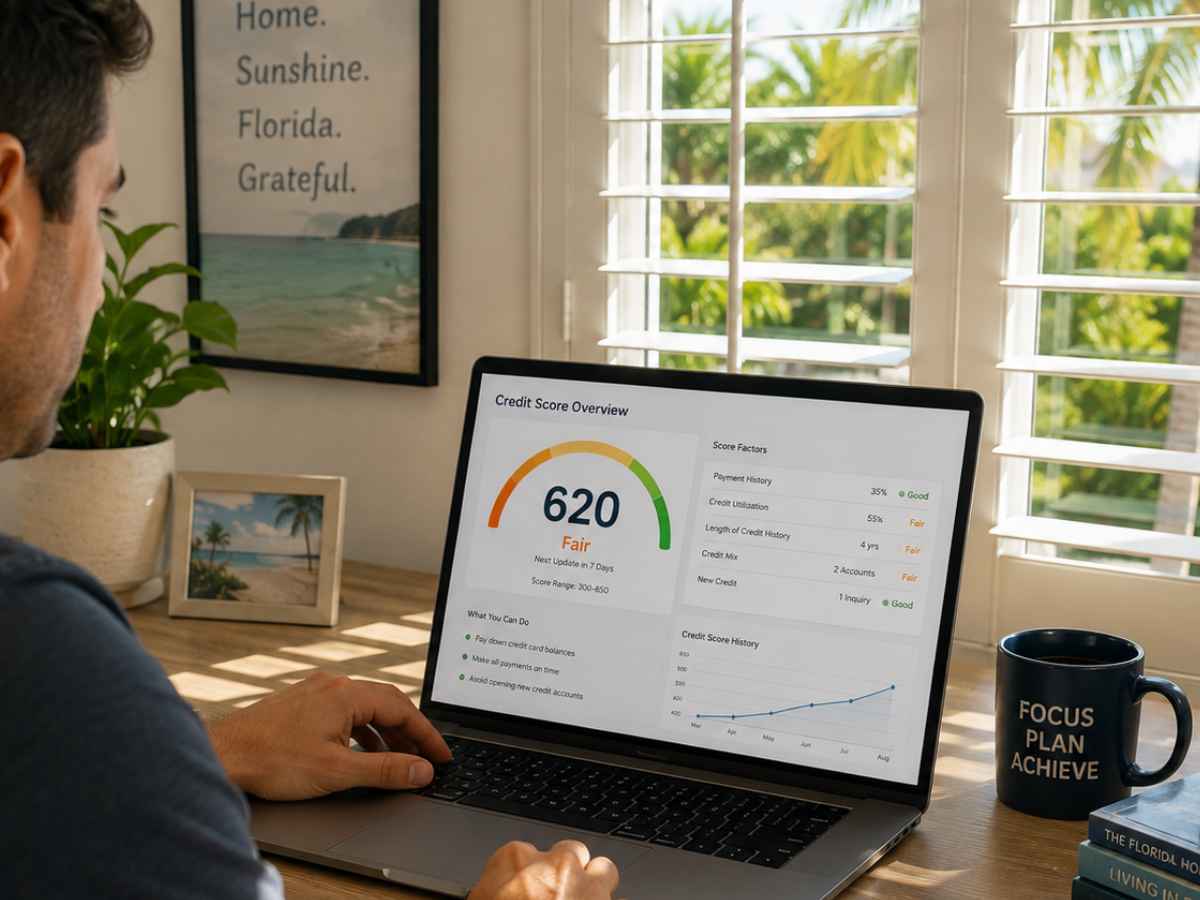
Key Takeaways:
- Most Florida borrowers need a minimum 580 credit score to qualify for an FHA loan with the standard 3.5% down payment.
- Scores between 500–579 may still qualify, but require a 10% down payment and stricter lender scrutiny.
- FHA loans are one of the most accessible mortgage options in Florida, especially for first-time buyers navigating a competitive housing market.
If you’ve been thinking about buying a home in Florida but aren’t sure your credit history is strong enough, you’re asking exactly the right question. FHA loans exist precisely for situations like yours — and understanding the credit score thresholds can help you figure out where you stand and what your next move should be.
Let’s break it down clearly.
The Minimum Credit Score for an FHA Loan in Florida
The Federal Housing Administration (FHA) sets baseline credit requirements that lenders across Florida must work within. Here’s what those thresholds actually look like:
- 580 or higher: You qualify for the minimum 3.5% down payment
- 500–579: You may still qualify, but your required down payment jumps to 10%
- Below 500: You are generally not eligible for FHA financing under standard guidelines
These aren’t suggestions — they’re hard floors set by HUD (the U.S. Department of Housing and Urban Development). That said, individual lenders often apply what’s called an “overlay,” which means they can require a higher score than the FHA minimum. Many Florida lenders, for instance, prefer to see a 620 or even 640 before they’ll approve you — even though the FHA technically allows 580.
This is an important distinction. When people get confused or frustrated during the loan process, it’s often because they met the FHA’s standard but didn’t meet a specific lender’s internal threshold.
FHA Credit Score Tiers at a Glance
| Credit Score Range | FHA Eligible? | Minimum Down Payment | Typical Lender Approval Likelihood |
|---|---|---|---|
| 740+ | Yes | 3.5% | Very High |
| 680–739 | Yes | 3.5% | High |
| 620–679 | Yes | 3.5% | Moderate to High |
| 580–619 | Yes (FHA min) | 3.5% | Moderate (depends on lender overlay) |
| 500–579 | Yes (with limits) | 10% | Low – fewer lenders willing |
| Below 500 | No | N/A | Not eligible |
The table above illustrates why credit score isn’t just a yes/no factor. It directly controls how much cash you need to bring to closing and how many lenders will actually work with you.
Why FHA Loans Are So Popular in Florida
Florida’s real estate market is genuinely intense. Prices in metros like Miami, Tampa, Orlando, and Jacksonville have climbed significantly over the last several years. That creates a challenging entry point for buyers who haven’t accumulated a large savings cushion or who’ve had past financial bumps.
FHA loans level the playing field in a few key ways:
- Lower credit score requirements than conventional loans (which typically require 620–660 minimum, and reward scores above 740 with better rates)
- Lower down payment — 3.5% versus the 5–20% common with conventional financing
- More flexible debt-to-income ratios — the FHA allows DTI ratios up to 57% in some cases, compared to the 43–45% typical ceiling on conventional loans
- Gift funds allowed — your down payment can come from family members, making homeownership reachable even without significant personal savings
For first-time buyers especially, these terms can be the difference between getting into a home now versus waiting years. If you’re exploring all your government loan options, FHA is almost always worth understanding first.
What Else Does an FHA Lender Look At Besides Your Credit Score?
Credit score is a gatekeeper, but it doesn’t tell the whole story. Florida FHA lenders evaluate your full financial profile. Here’s what they examine closely:
Debt-to-Income Ratio (DTI)
Your DTI measures your monthly debt obligations against your gross monthly income. FHA guidelines generally cap this at 43%, though compensating factors (like strong cash reserves or a high credit score) can push approval at higher DTIs.
Employment History
Lenders want to see at least two years of consistent employment. Self-employment is accepted, but requires additional documentation like two years of tax returns.
Down Payment Source
Your down payment must come from verifiable, acceptable sources. This includes personal savings, gift funds from family, or eligible down payment assistance programs.
Property Condition
FHA loans require the property to meet specific health and safety standards. An FHA appraisal is more stringent than a conventional one — the home needs to be move-in ready and free of major structural, safety, or habitability issues.
Bankruptcy and Foreclosure Waiting Periods
If you’ve had a bankruptcy, FHA requires at least two years from discharge (Chapter 7) before you can apply. A prior foreclosure typically requires a three-year waiting period.
How Your Credit Score Affects Your FHA Mortgage Rate
Your rate isn’t determined solely by whether you qualify — your credit score actively shapes how expensive your loan becomes. A borrower with a 740 credit score will get a meaningfully lower interest rate than someone approved at 580, even on the same FHA product.
That difference in rate compounds across a 30-year mortgage into tens of thousands of dollars. Even a 0.5% rate difference on a $350,000 home can change your monthly payment by $100 or more and your total interest paid by $30,000–$40,000 over the life of the loan.
This is why, if your score sits in the 580–619 range, it’s worth running the numbers before rushing to close. Sometimes waiting six to twelve months to get your score above 640 or 680 saves you significant money over time. A mortgage broker who knows the Florida market — and who has access to multiple lender products — can help you model both scenarios side by side.
FHA Mortgage Insurance: What Florida Buyers Need to Know
One thing that catches buyers off guard is FHA mortgage insurance. All FHA loans — regardless of your credit score or down payment — require two types of mortgage insurance:
- Upfront Mortgage Insurance Premium (UFMIP): 1.75% of the loan amount, typically rolled into the loan
- Annual MIP: Ranges from 0.15% to 0.75% of the loan amount annually, paid monthly
Unlike conventional PMI (private mortgage insurance), FHA MIP doesn’t automatically fall off when you reach 20% equity — at least not for most borrowers. If you put down less than 10%, you’ll pay MIP for the life of the loan. If you put down 10% or more, MIP drops off after 11 years.
This is a real cost consideration, and it’s one reason some borrowers with stronger credit profiles eventually refinance out of their FHA loan into a conventional product once they’ve built equity.
How to Improve Your Credit Score Before Applying
If your score isn’t where it needs to be yet, that’s not a dead end — it’s a timeline. Here are concrete steps Florida buyers use to move the needle:
- Pay down revolving debt first. Credit utilization (how much of your available credit you’re using) accounts for 30% of your FICO score. Getting each card below 30% of its limit — ideally below 10% — can produce fast score improvements.
- Dispute reporting errors. Pull your reports from all three bureaus (Equifax, Experian, TransUnion) and look for inaccurate late payments, incorrect balances, or accounts that aren’t yours. Disputes that succeed can raise your score quickly.
- Avoid opening new accounts. Each new hard inquiry temporarily dips your score. In the six months before applying for an FHA loan, keep new credit applications to a minimum.
- Keep old accounts open. Length of credit history matters. Closing an old credit card you no longer use can actually hurt your score by reducing your available credit and shortening your average account age.
- Make every payment on time. Payment history is the single largest component of your score at 35%. Even one missed payment can set you back meaningfully.
If you want a realistic assessment of where your score needs to go and how long it will take, a conversation with an experienced Florida mortgage broker is far more useful than a generic online calculator.
FHA Loans vs. Other Florida Loan Options: Which Is Right for You?
FHA isn’t the only path to homeownership. Depending on your situation, other loan types might serve you better — or complement your planning as your financial profile strengthens.
VA Loans are worth exploring if you have military service history. VA home loans require no down payment and no mortgage insurance, making them one of the most powerful benefits available to eligible veterans and active-duty service members in Florida.
Conventional Loans become more attractive once your credit score climbs above 700 and you have a solid down payment. They offer more flexibility around property types and can eliminate MIP faster than FHA. Explore your conventional loan options if you’re approaching that threshold.
Doctor Loans are a specialty product worth knowing about if you’re a medical professional carrying significant student loan debt. Doctor loans often exclude student loan debt from DTI calculations and offer high loan amounts without PMI.
And of course, for buyers whose primary path is FHA, working with a team that specializes in FHA loans in Florida means you get guidance tailored to how that specific product performs in this specific market.
Working With a Florida Mortgage Broker vs. a Bank
When you apply for an FHA loan through a bank, you’re limited to that bank’s products and overlays. If their internal policy requires a 640 minimum and your score is 610, you’re turned away — even if another lender would approve you at 580.
A mortgage broker works differently. They have access to multiple lenders, multiple underwriting standards, and can shop your profile to find who will actually approve you at the best possible rate and terms. For borrowers with credit scores on the lower end of the FHA spectrum, this flexibility is often the difference between closing on a home or not.
Liberty Mortgage Lending Group serves homebuyers and those looking to refinance across all of Florida. The goal is to make the process straightforward, local, and personal — not to run you through a call center that forgets your name by the second conversation. Whether you’re buying your first home in Tampa, upgrading in Orlando, or refinancing a property in South Florida, the approach is the same: find you the best rate, for your situation, with clear and honest guidance every step of the way.
Frequently Asked Questions
What is the minimum credit score for an FHA loan in Florida?
The FHA sets a national minimum of 500. However, to access the standard 3.5% down payment, you need at least a 580. Many Florida lenders apply internal overlays and prefer scores of 620 or higher before approving an application.
Can I get an FHA loan in Florida with a 550 credit score?
Technically yes — scores between 500 and 579 are within the FHA’s eligible range. But you’ll need a 10% down payment, and finding a lender willing to approve at that score requires working with a broker who has access to multiple underwriting options.
How long does it take to improve my credit score enough for an FHA loan?
It depends on what’s dragging your score down. Paying down high credit card balances can produce noticeable improvement in 30–60 days. Recovering from a missed payment takes longer — typically six months to a year before it stops heavily affecting your score.
Does my credit score affect my FHA mortgage rate in Florida?
Absolutely. Higher scores unlock lower interest rates. Even modest improvements — moving from 600 to 640, for example — can reduce your rate enough to save hundreds of dollars per year and tens of thousands over the loan’s life.
Are FHA loans only for first-time buyers in Florida?
No. FHA loans are available to any qualifying buyer, not just first-timers. That said, they are most commonly used by first-time buyers because the lower down payment and flexible credit requirements are particularly helpful early in your homeownership journey.
Liberty Mortgage Lending Group is proud to serve homebuyers and homeowners throughout Florida. If you’re ready to find out where you stand and what loan options fit your situation best, reach out today — because the right mortgage, for the right home, starts with the right conversation.